Research
Our research deals with the analysis of complex systems that can be abstracted as networks or graphs. A central methodological issue underlying our work is how one can study and integrate the multiple levels of organization which are commonly found in a range of systems. Our research combines ‘bottom-up’ dynamical models, and ‘top-down’ data-driven approaches, and uses a blend of tools from control theory, dynamical systems, stochastic processes, machine learning and statistics.
- For more information on our current ERC project HIGH-HOPeS, please visit the HIGH-HOPeS research page.
Studying Connections — Networks as Relational Data

Within network analysis and graph mining, broadly construed, we often focus on relational data. Indeed, much of the main focus of Network Science has initially been to chart and comprehend the connectivity patterns of real-world networks. Stated differently, the data corresponds to the edges (connections) of a network, and we aim to learn about a system by finding patterns in these stochastic connections. Some of the most important areas of Network Science thus include community detection (graph clustering), or the ranking of nodes according to centrality measures such as PageRank, HITS scores, etc. More recently, we have also considered approaches for the related problem of finding (symmetry-based) roles in networks, and investigated issues related to the statistical detection of hierarchical arrangements of communities.
In applications, we are often confronted with only one observed network sample, in which the observed network edges are subject to uncertainty. In these situations we thus need to adopt a statistical perspective to account for the uncertainty in the data and reach robust conclusions.
Studying data on networks — dynamics and signals on graphs

Understanding how network structure can impact dynamical processes on those networks, e.g., the formation of opinions or the patterns in spiking neurons, is another main theme of our research. Indeed, in many problems emerging from control theory and dynamical systems, we consider a distributed dynamical system supported on a graph structure. The edges are typically defined with low uncertainty and mediate the interactions of a coupled dynamical process on the nodes we aim to understand. Our work focuses on understanding such dynamics and data on networks in a more principled way by taking into account the underlying network structure.
Similarly, fast-growing parts of signal processing and machine learning are concerned with data supported on the nodes of a graph. Here the graph is considered a fixed entity, which is either given, or constructed from (high-dimensional) data, and our primary goal is to leverage the graph structure to make inferences about data supported on the nodes. Graph-based semi-supervised learning is a concrete example: here, the graph structure is utilized to extrapolate from a few known node labels to all node (data point) labels, by enforcing smoothness along the graph edges. Most prominently, however, the utility of graph-based learning has been exhibited in the recent rise of graph neural networks, on which we are also working.
Studying high-dimensional data via graphs and complexes — topological data analysis

High-dimensional (point-cloud) data commonly contains some geometric or topological information. Topological tools enable the classification of topological or geometric structure, for instance, the detection of possible clusters in the data. A central notion for the analysis of such point cloud data is often that the observed data is assumed to be a noisy sample from a low-dimensional topological or geometric object, such as a manifold embedded in a larger sample space. To reveal the shape of this manifold, we can construct a graph that serves as a discrete proxy for this continuous object: The vertices correspond to the data points, and two vertices are connected by an edge if the distance between the corresponding data points is sufficiently small. The resulting (family of) graphs can then be analyzed to provide a low-dimensional representation of the data, e.g., by considering distance measures on the graph, rather than in the ambient space of the data. The idea of approximating the global geometric structure of high-dimensional data using graphs naturally generalizes beyond local pairwise geometric relationships to local multi-way geometric relationships, leading to the definition of (simplicial and cellular) complexes, whose analysis can reveal important properties about the underlying data — which is the central tenet of topological data analysis. The complexes constructed in this way also give rise to a hierarchy of Hodge-Laplacians, which include the graph Laplacian matrix as a special case, and can be used to extract geometric and topological information about the data.
Interdisciplinary Applications
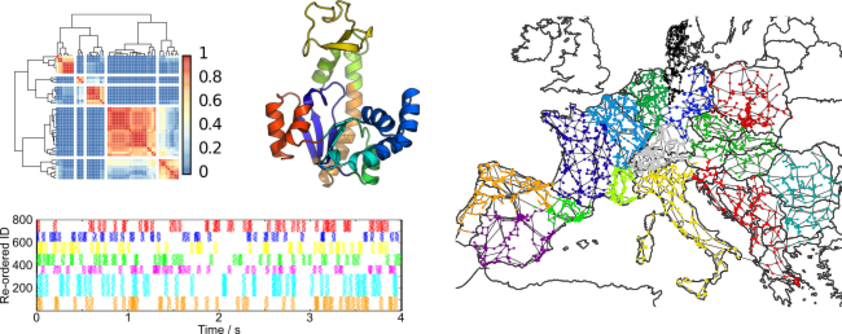
One of the strengths of network models is their versatility: networks have become ubiquitous abstractions for social, physical, biological and engineered systems. Facilitated by our multidisciplinary background, we work on a range of applications. We are particularly interested in biological problems, such as the analysis of neurophysiological data or the analysis of proteins and genetic data, and on applications concerning social systems such as opinion formation in social networks and modelling systematic bias.